Spotlight On Water Resources: Behind the Scenes with Water Service Crews
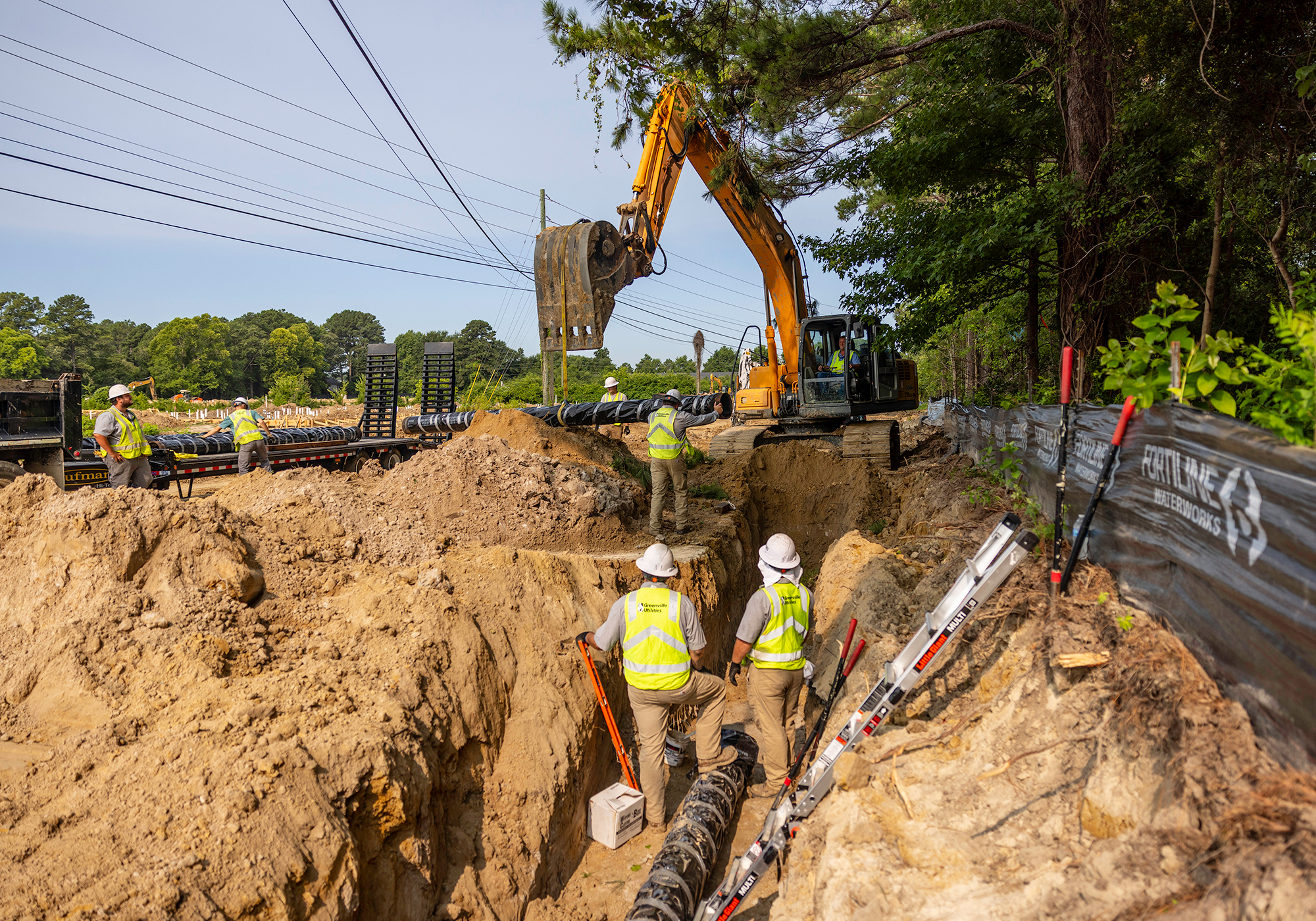
Service crews relocate and install a water main on Radio Station Road.
Water Resources (WR) service crews address water and sewer issues from customers and repair and install services along 735 miles of lines spanning as far north as Bethel and as far south as Winterville. With nearly 41,000 water customers within the Greenville Utilities water system, they are the water/sewer first responders, leak investigators, and light construction point team for installation and repairs.
Light Construction Gone Heavy
At 8:30 a.m. off Radio Station Road, a side street sprouting from Stantonsburg Road, it is already 80 degrees. It will reach the mid 90s on this day, with the heat index feeling like 105 degrees by mid-afternoon. Surrounded by fill dirt, pipeline, and development construction materials, WR Systems O/M (Water) Crew Leader I (Water) Josh Setzer addresses the heat in the Job Safety Briefing (JSB) as his crew of four and Water Resources Systems O/M Crew Leader II (Sewer) Linwood Smith’s crew of three stand in a semicircle with full attention.
“It’s hot, so take breaks and get in the truck to cool off if needed,” he said.
He goes on to discuss proper rigging, excavator and pipe safety, personal protective equipment, and situational awareness on the job site, concluding with “if you’re not needed in an area, don’t be there.”
The job, on this occasion, is a step away from what the light construction service crews are familiar with. They would normally handle repairs and installation of ¾-2-inch water pipelines and 4-6-inch sewer service lines.
“We typically do water service and sewer service, but for this we are giving the guys more exposure into the construction side of things,” Josh said. “There are a lot of things that have changed and cross training allows our crews to do a lot more when it’s needed.”

In 2025, WR service crews completed 765 repairs, cleared 98 sewer stoppages, and installed 582 new water connections.
This project is a relocation and installation of a water main with 10-inch ductile iron piping after contractors damaged the last one. Contractors building an apartment complex on the vacant lots along Radio Station Road were clearing trees and pulled up a tree stump, along with the water main that was wrapped in the tree roots.
“We have to relay the main farther away from the tree line, so they won’t cause any other issues,” Linwood said.
Josh and Linwood have worked on the heavy construction side of Water, making them comfortable leading the teams and confident in the ease in which laying this main can be taught.
“I laid water mains all in Belvoir, along Corey Road in Winterville, and a force main on County Home Road. I cut my teeth on construction,” Josh said. “This is a pretty straight-forward job, which is why it’s good for training. All we have to do for this is put in a valve, and there is nothing in the way. It’s just dig and lay.”
They work together like a well-oiled machine, making it appear that this job was a natural fit for the teams, even though it was a training experience.
WR Systems O/M Technician IV David McKeel uses the excavator to pick up the large pipe from the truck bed and maneuvers it into the 3-foot-deep hole. Once it’s there the five crew members work to complete the installation of this portion, while the remaining crew members prepare other materials for installation.
WR Systems O/M Supervisor (Sewer) Keith Clark chose this project, seeing it as a chance to grow the skills of the service crews that he supervises. He said, “I thought this water main project would be good for the crews especially the younger guys that have never been involved on this side of things from laying pipe to operating some of the bigger equipment. It was a great opportunity for the guys to get hands on experience with water main installation work and to further their knowledge. The most important part is the crews were able to complete the job safely.”

Hello? Is It Service You’re Lookin’ For?
On the service truck, WR Systems Crew Leader I (Sewer) Dylan Morris and Systems O/M Technician II (Sewer) Quentin Pool respond to customer calls about leaks and low water pressure, and requests to turn off meters for construction and plumbing contractors.
Their day begins with a job safety briefing (JSB) in the service truck, where safety instructions and precautions were addressed, much of the same things as the construction crew reviews, but with an additional warning to be vigilant of sharps exposures – such as hypodermic needles, broken glass, and cracked bricks.
“You never know where we are going to get called to and what we are going to need to do,” Dylan said.
Quentin enjoys the changing nature of working the service truck.

“I like not being stuck in one spot all day,” he said. “You’re always seeing something different.”
They have a variety of work orders, including assisting Josh’s crew in a residential neighborhood, but before they get there,
they respond to a call about a steady stream of water in an apartment complex parking lot.
“The phone can ring from the time they come in until the time they leave,” Keith said. “They are our representatives out there. They are our first responders.”
The first stop of the day is an apartment complex on Williams Road. Once they arrive, the investigation begins.
A small stream of water is running downhill in the parking lot, indicating a leak. It is up to them to determine where it is coming from.
Dylan knocks on the apartment door closest to the meter and lets the customers know that they are inspecting for a leak.
Quentin works to find the meter box, and when he finds it, pops it open.
Dylan pulls out the listening stick -- an acoustic tool that picks up vibrations of pressurized water leaking from broken pipes -- and presses the top of it to his ear.
“Yes, there it is,” Dylan said after hearing the whooshing, ocean-like sound emanating from the stick. “There is a leak, and it’s on our side. The meter is also running on the customer side, too. They might have a small leak, like a running toilet. We’ll let them know.”

From there they locate where the water service is, which is the pipe running from the larger main to the line is and the pipe running from the larger line to the apartment’s meter. They identify the depth in which the line is buried. Utility Location Services will come out and locate any possible underground electric wiring, gas lines, or other fiber before any repairs can be made.
“We gather as much information as we can, so when they come out to make the repair, they know what tools they need to bring and exactly what they are coming to do,” said Dylan.
Dylan came from a construction background, and that experience helps them investigate customer concerns, isolate the issue, and gather all the information that the crews will need before they are dispatched to make repairs.
Dylan gives Staff Support Specialist II Jackie Coley a call at Station 5 to let her know what they found and to put in a work order for the repair of the leak and checks to see where to go next.
Station 5 acts as the Water Department’s control room. They are the liaison between the customers and the service trucks.
Water Resources Managing Administrative Assistant Nikia Best-Manuel said, “We get a lot of calls, but we filter them all to the appropriate places. We are always helping someone who is in need. I like helping resolve the problems.”
Nikia’s team of three answers customer calls where complaints run the gamut of low water pressure, damage to service, meter adjustments, and leaks. Using GIS and CCS they enter calls and dispatch service trucks through Teams chat.
Next Dylan and Quentin arrives to Josh's crew located in a residential neighborhood. They are covering a pipe that was repaired. The service truck was called out to find an additional clean out. Dylan extends the TV sewer line inspection camera in the pipe to search for the clean out – a process which took about 15 minutes.
Dylan and Quentin are just getting started. By the end of the day, they would have responded to up to 10 calls for service.