Spotlight On Operations Support: Behind the Scenes with Fleet
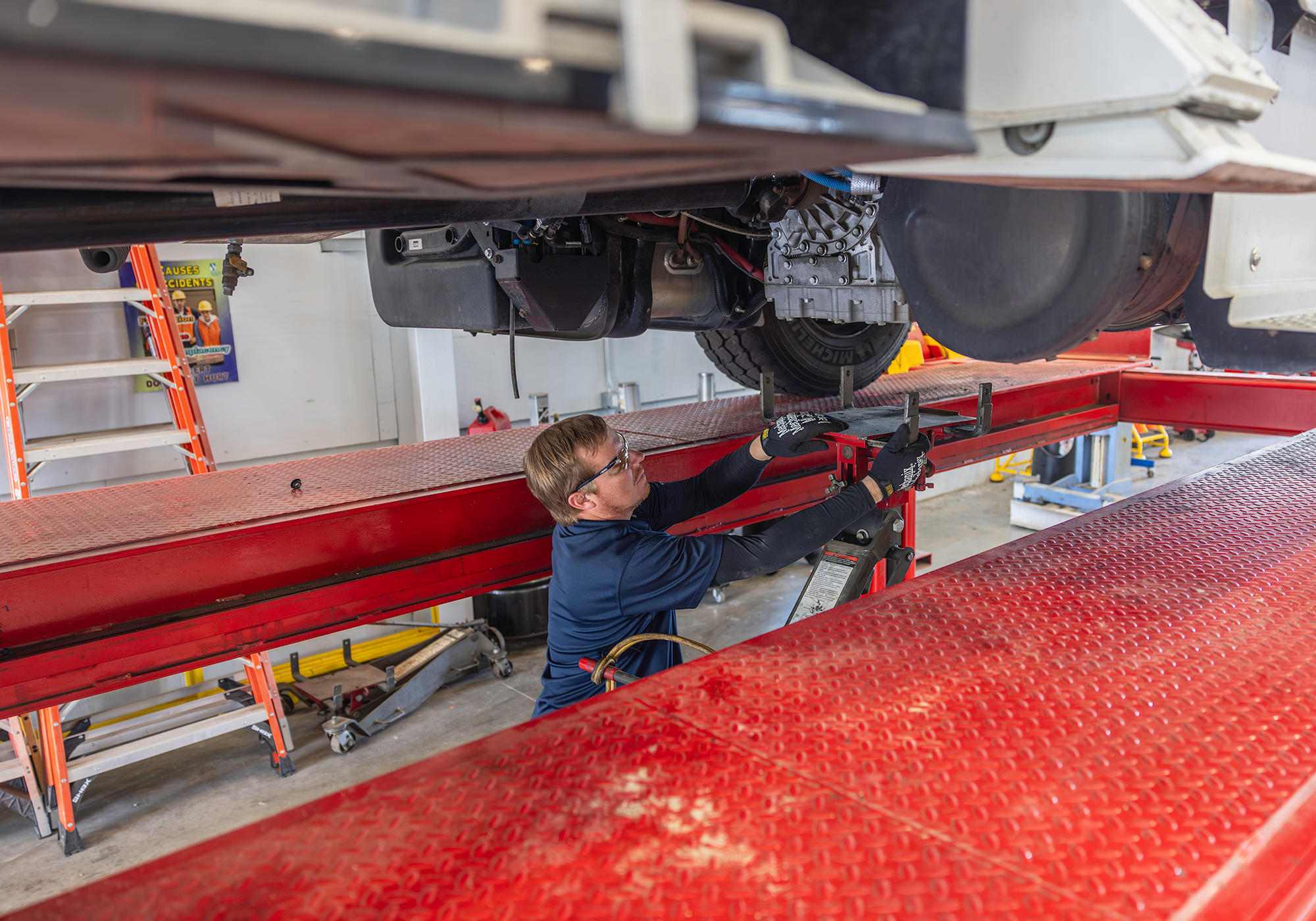
Master Mechanic Kenny McDonald starts the repair on heavy duty vehicle in the Fleet garage.
Operations Support’s Fleet Management Division oversees the comprehensive life cycle of more than 600 assets; vehicles, trailers, light, medium, and heavy equipment. This is how they do it.
Masters at Work
An excavator sits in the garage with its boom, stick, and bucket completely detached from the body. Master Mechanic Matt Edwards is midway through replacing the bushings on the machine.

He holds a roughened, worn bushing that will be replaced, and explains how a good bushing is smooth to allow for ease in movement and rotation. “You have to replace them just right for it all to fit back together and work,” Matt said.
“That’s why we get them cold first,” said Master Mechanic Eric Roberson. “It makes them shrink so they fit better.”
Most areas in the garage have heavy duty vehicles, trucks, and equipment waiting for repair or maintenance.
The Master Mechanics in Fleet are on a level all their own.
With five Masters working in the garage, there is an extensive knowledge base that ensures that the more than 600 vehicles, trailers, and light, medium, and heavy equipment can be properly repaired and put back into working order.
“Our job is to partner with the organization, collaborate to understand its needs, acquire and manage fleet assets, and execute a maintenance program that ensures those fleet assets remain safe, reliable, and available to support operations,” said Fleet Manager Scott Brinson.
Mechanic Supervisor Kevin Lockamy sees the results of Fleet mechanics problem solving skills, intelligence, and mechanical expertise every day. “I have a good group of guys down here – a really talented and knowledgeable group,” Kevin said.
It’s the Master Mechanics who keep GUC from sending vehicles and equipment off campus for repairs and getting the vehicle/equipment up and running when there is a breakdown in the field.
Kevin said that on one occasion a warranty repair resulted in Fleet sending out a heavy-duty truck to a specialty company to get repaired. “They couldn’t figure it out,” Kevin said. “It got sent back to us, and we fixed it. Not only that, but we figured it out, did the repair, and now we have the equipment to fix that issue again if it ever comes up in the future.”
Being a Master Mechanic involves a lot of routine work, but it also involves problem solving, knowledge of different vehicle software programs, and knowing the inner workings of the equipment or vehicle in repair.
“Our Mechanics combine technical expertise, diagnostics, leadership, and decision making to ensure the fleet remains safe, efficient, and cost-effective to operate,” Scott said.
“They can perform virtually every type of repair, including complete engine overhauls. They also possess extensive technical expertise in vehicle electronics and computer systems, as modern fleet assets are equipped with sophisticated onboard technology. In addition to mechanical repairs, they diagnose, maintain, repair, and program electronic control systems, making them both skilled technicians and technology professionals.”
Eric takes what appears to be daunting tasks in stride. He said in his experience, solutions are often found in the most obvious answers. “To figure out how to fix a problem, I learned you have to keep it simple,” Eric said.
For Master Mechanics, to “keep it simple” requires knowledge of physics and computer science, along with practical knowledge of every make and model of vehicles, trailers, backhoes, excavators, and everything else in the GUC fleet.

Prevention & Maintenance
Fleet Management completes more than 110 preventive maintenance (PM) services and more than 200 repair services each month. On average, approximately 150 fleet assets move through the facility monthly for maintenance and repair. Despite this volume, the team consistently maintains greater than 95 percent PM compliance, ensuring assets receive scheduled maintenance on time.
Additionally, fleet asset availability (24/7 uptime) across all asset types exceeds 96 percent. “This means that fleet assets are available for service more than 96 percent of the time, enabling Greenville Utilities to reliably support its operations and serve its customers.” Scott said.
Fleet has two Mechanic I’s on staff and a pre-apprentice who perform the majority of the light duty, trailer, and other equipment PMs. “Our mechanics work together like a well-oiled machine to support our customers and achieve such an outstanding PM compliance and uptime rate, and this work starts with a report, a phone call, or a customer visit,” Scott said.

That report, phone call, or visit first goes to Service Writer John Britt who coordinates the timing of every PM and repair.
“Anything that breaks down comes through here first,” John said while holding a long list of vehicles that are to get a maintenance service that day.
“I write a ticket and dispatch it to the mechanics. It begins at 7 a.m. and doesn’t slow down. I also schedule out the PM work on a daily basis. Everything we have is on a maintenance schedule. We stay busy.”
To keep such a high PM rate, work is coordinated through Fleet management software.
“We use our Fleet Management software system to track maintenance costs, fuel usage, fuel inventory, and fleet replacement cycles, but it also serves as a critical tool for our technicians,” Scott said. “The system helps mechanics access asset information, document repairs, manage PM schedules, track labor and parts usage, and maintain accurate service records, allowing us to operate more efficiently and make informed fleet management decisions,” Scott said.
Each job performed is assigned a standard labor time. Some standards are based on industry benchmarks, while others have been developed specifically for GUC Fleet Operations.
Improving and Growing
In the last three years, Fleet has seen changes in processes, vehicles, and equipment and parts. Those changes were implemented to create a more streamlined and efficient workflow that keeps everything moving.
The Fleet motor pool has expanded to include utility trucks, lighting equipment, backhoes, mini excavators, air compressors, and other specialized equipment. Prior to the growth, the pool was primarily small trucks and vans. These assets are not assigned to a specific department but serve as shared resources across the entire Commission.
Fleet’s parts management system shifted to NAPA Integrated Business Solutions in March of 2025.
“One of the key advantages of this partnership is that GUC no longer carries the cost of maintaining inventory,” Scott said. “Instead, GUC only pays for parts when they are issued to a work order, significantly reducing inventory costs while improving parts availability. The partnership has been a significant improvement for our operation, ensuring mechanics have timely access to the parts they need.”
GUC is standardizing the assets across the entire fleet, as well. Fleet standardization improves maintenance efficiency, reduces inventory costs by limiting the variety of parts that are needed, simplifies operator and technician training, and increases asset availability through faster repairs and improved parts support.

Fleet Management meets annually with each department to discuss operational needs, review equipment performance, and identify future requirements.
Kevin, who previously worked in Water Resources and as a former Master Mechanic, has experiential understanding of what crews need concerning equipment and vehicles.
“I like that I come from an entirely different level and built relationships all the way through,” Kevin said. “I understand the different departments’ operational needs.”
Another part of Kevin's job is to support the Masters and Mechanic I’s. He ensures the mechanics receive the proper – and advanced – training, supports them when they need it, and recruits knowledgeable technicians. He also works with Master Mechanic Kenny McDonald on prioritization of daily tasks, and with Scott on asset replacements.
For Kevin, his eye remains on the future and cultivating skills and talent within Fleet that offers him the most reward. As a supervisor, Kevin said one of his proudest moments was to watch a Tradesformers Pre-apprentice grow and become a full-time employee at GUC.
“To see him come from the Tradesformers program and to see him grow and excel and become hired on as a mechanic is something I am proud of. I’ve watched him grow and excel in many ways and that is rewarding for me.”