Control Room Operations Supervisor Russ Carson
The Control Room is a 24 / 7 operation for electric, gas, sewer, and water. It monitors a system of 3,183 miles of electric lines, 25 substations, 758 miles of gas mains, 541 miles of gas service pipelines, 731 miles of water lines, and 446 miles of sewer lines. The Control Room operates the SCADA (Supervisory Control and Data Acquisition) and Outage Management Systems, load management activities, and also handles after-hours customer service calls. Operators know a lot about each aspect of the utilities, and their knowledge is tested every day. They ensure the safety of employees and the security of facilities, infrastructure, and reliability; implement effective load management; and maintain strong customer service no matter the day or time.
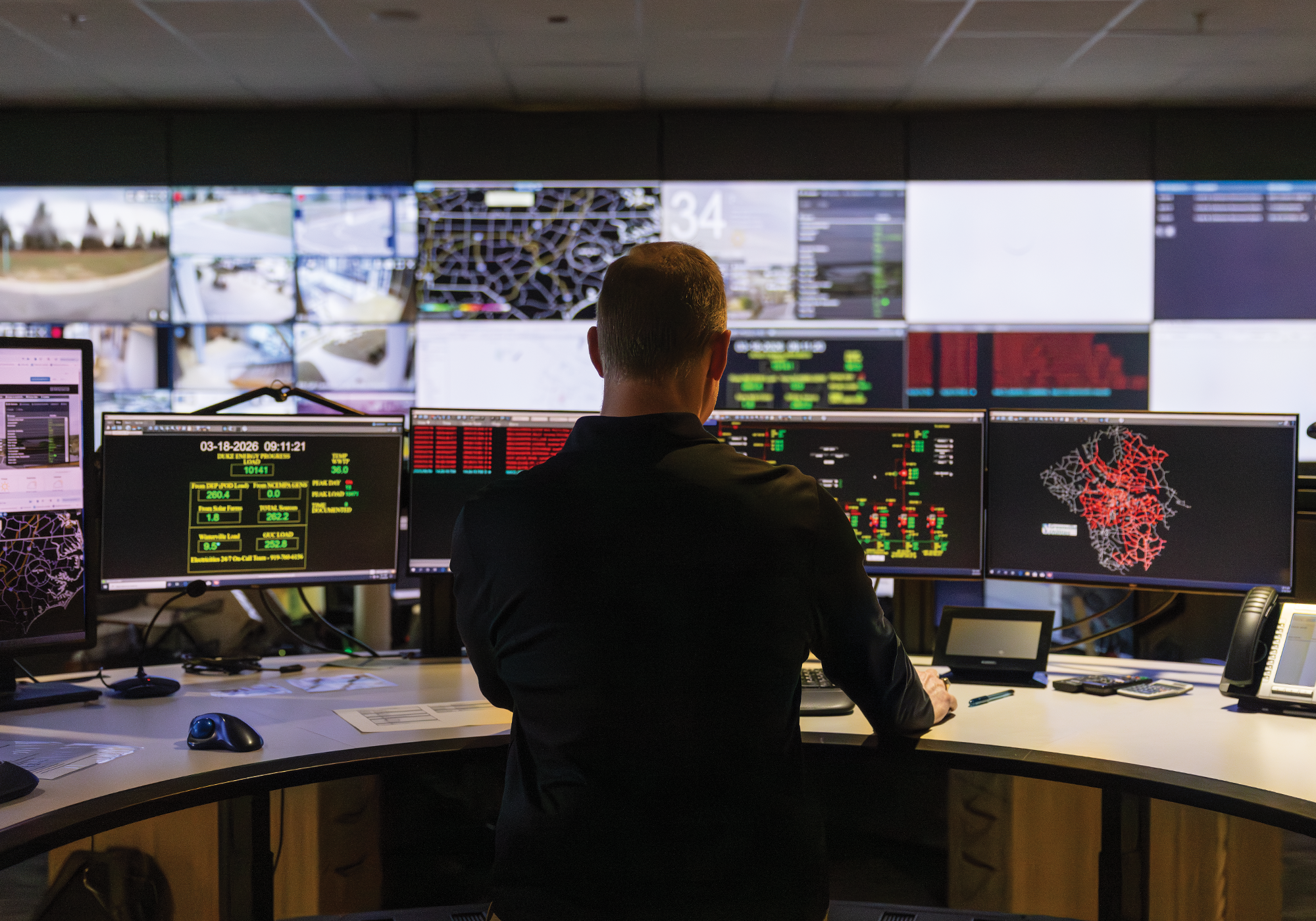
Persistent beeps from substation alarms fill the air and one of many screens that line the wall of the control room. Control Room Operator II Sharon Comacho silences them and, one by one, dispatches electric crews to check on the cause and creates work orders for each issue in CityWorks.
The day is sunny with a moderate temperature, which plays a role in how busy the Control Room can be.
“These alarms are at substations, so we make sure unauthorized people aren’t going in. Those alarms also depend on the temperatures outside, too.” said Sharon.
Sharon and Control Room Operator I Sonya Elks are three hours into their 12-hour day shift. Their day begins at 7 a.m. and is typically full of coordinating work orders for maintenance, monitoring facilities, taking customer calls, and running load management.
“Most days are good,” Sharon said. “A good partner makes it better, too.”

Both Operators keep an eye on the security cameras placed at the substations and all GUC facilities. They monitor SCADA; electric and gas needs during the day; and are tuned into 16 radio channels and several phone lines all at the same time.
“Sometimes, it’s really calm, then its chaos all of a sudden,” Sharon said.
“You have to know a little bit about everything. When a call makes its way in here, it is our responsibility.”
Control Room Operations Supervisor Russ Carson said the Operators have to be exceptional at multi-tasking and understanding multiple aspects of the utility world.
“It can be busy during the day with gas and electric,” Russ said. “We dispatch the crews. On the weekend and after hours we also take water calls. Operators manage work orders, get information about car accidents involving poles, manage service requests, and monitor substations and circuits under maintenance. Operators have to be adaptable. There are about 1,000 things you need to know. The training process takes four months to a year. There are so many things that may arise that you have to know how to handle.”
After four to six months of training, an Operator may be able to run the control room alone, but there is still more to learn.
Russ said depending on the day, whether it’s a storm event, car accident, or other factors that may contribute to service interruptions, the Control Room can get anywhere from 50 calls on a calm day or up to 400 on extreme days.
During the night shift, from 7 p.m. to 7 a.m., the Control Room is calmer, but never quiet. Control Room Operator I Jeff Upright enjoys the night shift work.
While routine maintenance on electric lines may not be the top of the list of work to do in the evening, the nighttime Operators handle all customer calls, including water and gas service calls, substation monitoring, and car accidents involving poles and other GUC infrastructure.
“I enjoy coming to work, and that is a fact of life for me,” Jeff said with a smile as he answered the ringing phone.
On the line is a customer who broke a spigot in their home. They ask for someone to come out and turn their water off at the meter so they can stop the water flow. Jeff tells them he will get someone out there and immediately calls a Meter employee who is on call to head out to the customer.
“We are on call for customers after Customer Service representatives leave for the day. We handle everything but payment processing,” he said. “Anything that happens after hours comes here – water, gas, electric and sewer. There is so much complexity to what goes on here. There is complexity to every single segment. Every day, you learn something new.”
Maintenance & Repair
The Greenville Utilities electric system has 3,183 total miles of lines to maintain with 25 substations that serve more than 76,000 customers. While crews work on the outside to maintain and repair lines, Control Room Operators ensure they can do that work safely.
“We can shut a circuit down for the safety of the electric system. We can one shot a circuit for safety, and then we have the switching orders where electricity gets rerouted for maintenance,” said Jeff.
One shot is a term used in SCADA. Breakers typically open up and close four times when there is a fault detected on the line – normally it’s a tree limb, bird, or squirrel – and that sudden voltage will knock something small off the line. When Operators change it to “one shot,” they change the breaker settings so if the circuit opens up (and stops the flow of electricity), it will stay that way instead of re-energizing four times. This is a precaution to keep linemen safe as they work on maintenance and repair.
Switching orders allow for customers to keep their service going while giving crews a safe way to maintain electric infrastructure. They require engineers or substation supervisors to develop a plan for rerouting electricity. Control Room Operators enter those orders into the system.
Electric crewmembers going out to do routine maintenance on substations also call into the Control Room to tell an Operator they are at the location to ensure employee safety.

Load Management
Under Russ’s leadership, the Control Room also saves GUC roughly $1.5 million a month by reducing electric demand and wholesale power costs through a complex load management program.
For the one hour of peak energy usage each month, GUC’s wholesale power provider raises the cost of electricity from 2 to 3 cents a kilowatt hour to $23 a kilowatt hour. Fifty-three percent of GUC’s wholesale power costs are from that single one-hour of peak time energy usage.
Electric wholesale costs have the capability to skyrocket if there were no efforts to lower use in that one-hour time period. That is where the load management program plays a significant role.
Russ, with 24 years of collected energy use data trends and professional experience, makes the prediction of when the peak demand time will be and makes the call to reduce system-wide energy use.
“For load management we use a lot of historical data,” he said. “It is kind of like trying to tell the future. It’s exciting. I do enjoy that. The whole process is a challenge. It’s always something new.”
The first thing the Control Room will do during peak time is lower voltage at the substations by 4 percent.
“Also, at the top of the hour we think we are going to peak, we will start up the peak shaving generators at industrial sites and our facilities,” Russ said.
Next, they activate the residential program, Beat the Peak, where water heaters, air conditioning units, and heat pumps will be turned off for 20 minutes out of the hour for the enrolled customers. Thirty percent of GUC electric customers participate in this program that controls approximately 44,000 appliances.
Finally, Russ discharges the 1MW/2MWh battery located at the Evans Substation. These lithium-ion batteries are charged from the grid during off-peak times.
The Load Management Program is an integral piece of how GUC is able to keep electric rates low for customers; lowering our wholesale bill hundreds of thousands of dollars each month.
The Control Room recently adjusted its shifts from three rotating 8-hour shifts to 12-hour set shifts. Day shifts are 7 a.m. to 7 p.m. and night shifts are 7 p.m. to 7 a.m. This change offers Operators more consistent times to be off. A 14-day schedule looks like working Monday, Tuesday, Friday, and Saturday one week, and Sunday, Wednesday and Thursday the next week.